


Sustainability Approach
MIT’s approach to sustainability is firmly grounded in strong and effective governance provided by the Board.
The Board is supported by several committees, which oversee the implementation and operationalisation of the Board’s sustainability plans. These committees comprise a wide range of roles and functions, which allow for effective oversight of MIT’s sustainability performance and progress. MIT’s wider sustainability governance structure includes representatives from both the Manager and the Sponsor, which ensures overall alignment with the Mapletree Group’s sustainability ambitions.

Sustainability Governance
To assist the Board in overseeing its sustainability strategy, MIT’s wider sustainability governance structure comprises several other committees and includes representatives from both the Manager and the Sponsor.
The wide range of roles and functions incorporated into the Manager’s sustainability governance structure ensures effective oversight of sustainability target setting and performance evaluation.
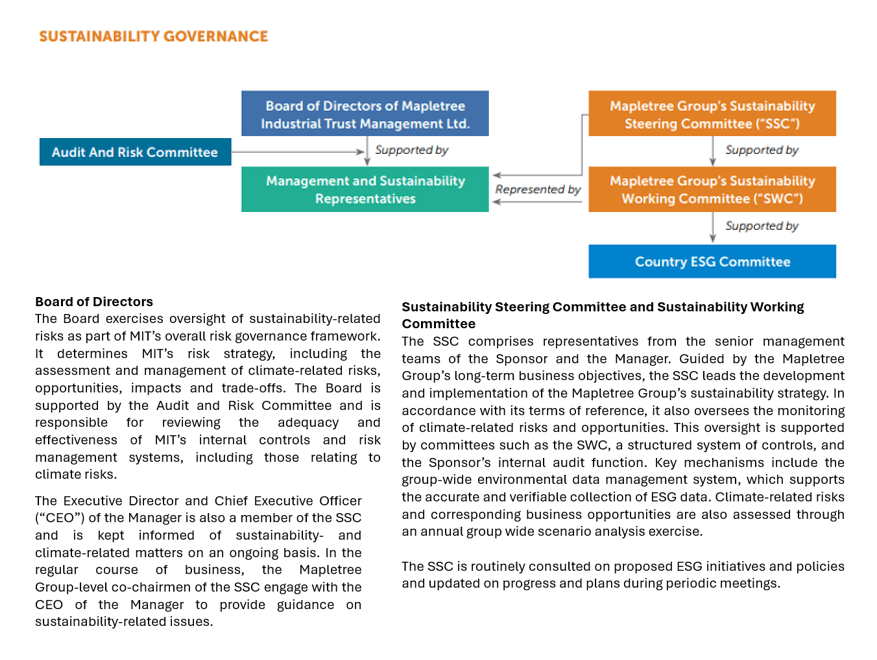
Board of Directors of Mapletree Industrial Trust Management Ltd.
- Overseas sustainability strategy and sustainability reporting
- Approves and monitors progress of sustainability targets and performance
- Receives updates on cirtical ESG issues
- Determines risk strategy and governance, including those related to climate-related risks and opportunities
CEO of Mapletree Industrial Trust Management Ltd.
Mapletree Group’s Sustainability Steering Committee (“SSC”)
- Co-chaired by Deputy Group CEO and Group Chief Corporate Officer (“CCO”) of Mapletree Group
- Spearheads the development of policies and initiatives that are aligned to Mapletree Group’s sustainabilit strategy
- Sets targets and drives sustainability initiatives
- Evaluates management approach to assess the effectiveness and relevance of existing policies and measures
Sustainability Representatives
Mapletree Group’s Sustainability Working Committee (“SwC”)
- Comprises representatives from various business units and corporate functions
- Implements, executes, and monitors sustainability plans, policies and practices
Country ESG Committees
- Champions and supports sustainability initiatives in each country where MIT operates
Materiality
The Manager recognises that an effective sustainability approach depends on understanding stakeholders’ key concerns and prioritising matters that are most relevant to both its business and stakeholders.
The Manager conducts an annual review of MIT’s material topics to ensure selected topics are aligned with evolving stakeholder expectations. In FY24/25, the Mapletree Group and the REIT refreshed their material topics through a double materiality assessment and engagement with key stakeholder groups, including employees, suppliers, tenants, contractors and investors. The assessment covered both impact and financial materiality, in line with global best practices.
In FY25/26, the Board reaffirmed the continued relevance of MIT’s existing material topics, which are grouped under four pillars: Economic, Environmental, Social, and Governance.
Materiality Reassessment Process
The Manager will continue to engage its stakeholders to periodically assess the relevance of the various material topics amid the evolving ESG landscape.
The material matters, targets and performance are summarised here.
A summary of Mapletree Group’s Environmental, Social and Governance-related policies can be found here. You may also read the summary in Chinese, Japanese and Korean.
Net Zero Progress
Aligned with the Mapletree Group’s sustainability direction, MIT continues to uphold the principles of the Paris Agreement and supports Singapore’s ambition to achieve net zero emissions. Guided by the Mapletree Group’s Net Zero 2050 Roadmap, the organisation is working toward absolute net zero emissions by 2050. Carbon credits for residual emissions will be evaluated and tapped on at a later stage when necessary. As MIT progresses along its net zero pathway, it encounters similar challenges faced by many organisations, particularly the limited influence it has over value chain emissions generated by tenants, suppliers and contractors. These external dependencies make some targets difficult to achieve. Despite these constraints, the Mapletree Group has identified a range of strategies and levers that will support and advance MIT’s overall decarbonisation journey.

Our Net Zero Commitment
Sustainability Highlights
33.1%
reduction in average landlord building electricity intensity for Singapore properties from FY19/20
42.6%
reduction in Scope 2 greenhouse gases emissions intensity for Singapore properties from FY19/20
15,995 MWh
renewable Energy generated in FY25/26
329
trees planted across MIT’s assets and multiple communities
3
properties attained WELL Health-Safety Rating in North America
16%
of MIT’s Singapore properties with operational control (by GFA) installed with electric vehicle charging points
Green Lease Leaders Award (Silver Recognition)
attained for MIT’s US Data Centre Portfolio
11
tenant events organised
139
employee volunteers for MIT’s CSR initiative
53.2 hrs
of average training hours per employee
100%
of employees received professional training relating to ESG topics
68.8%
of management positions held by women
46%
women representation on the Board
A
GRESB Public disclosure
BBB
MSCI ESG Rating
69%
independent directors on Board
0
material incidences of
non-compliance with relevant laws and regulations
13.9
Low Risk
Morningstar Sustainalytics ESG Risk Ratings
0
incidences of non-compliance with anti-corruption laws and regulations
Learn More in Our Latest Sustainability Report
Shaping Balance Building Strength